2. The Gold Standard
(A Normal Year’s Top 10 15)
In another year, without the number one category, these would be my top 15. Like all the other categories, these are not ranked, but simply in alphabetical order.
Molly: Nope.
Amy: No.
Molly: Not acceptable.
Amy: This is not okay.
Molly: Who allowed you to be this beautiful?!
Amy: Who allowed YOU to be this beautiful?!
Molly: Who allowed you to take … my breath … away?!
Amy: Call the paramedics. Call the police. Because there has Been. An Emergency.
Molly: I can’t look right at it.
Meet your new favorite sleepover movie. Just say no to the strawberries and keep away from the stuffed panda. The lazy way to describe this is “Superbad, but with girls.” But it’s so much more than that. The two central characters love each other so much that it’s impossible for us not to adore them too. There are details in here that will probably feel dated in 10 years (many of the political references, for one thing), but that’s true of all the best teen comedies. There are some truly gorgeous visuals that you wouldn’t necessarily expect in a movie like this — one of the most beautiful scenes I saw in a movie this year was the underwater pool scene, where Amy is trying to find her crush. The stop-motion sequence is incredible. The writing is fantastic, including some great foreshadowing when Amy says someone always gets arrested the night before graduation. But most of all, I love how much this movie loves ALL of its characters (even the wanted criminal, a little bit). There has been a great trend in a lot of movies this year where people are forced to reexamine their prejudices about other people, especially women's prejudices about other women, and this is the crown jewel of that trope among this year's movies.
You want to play it as good guys and bad guys. And I'm one of the bad guys. But I give these men respect, and as much dignity as I can, all the way through.
This was the last new film I saw this year, and I was floored. And I think it made an even bigger impression on me than it would have if I hadn't seen the Last Week Tonight segment on lethal injection. (Side note: I cannot believe that it never occurred to me before that aired that a doctor cannot be involved in administering a lethal injection, or even designing the device, because OF COURSE their oath prevents them.) Alfre Woodard plays a prison warden who has had to supervise a dozen executions by lethal injection in her tenure and you can see that it has taken a toll on her. The movie begins with number eleven, which goes very badly. This attracts the attention of the media and puts more focus on the upcoming twelfth execution, that of Anthony Woods (played by Aldis Hodge). There's an inevitability to where this movie is headed, but you can't look away because there's this tiny sliver of hope that something will change the course of fate. Alfre Woodard is as incredible as she has ever been (which is saying something), and her character looks at her job as a profession and does it to the best of her ability. She's not on a power trip. She treats those under her care with as much compassion and consideration as she can, within the rules and regulations. She doesn't take sides or give special treatment. And with very few exceptions she doesn't betray any emotions she might feel at what she has to do. This catches up to her when she leaves work, as she frequently gets a drink (or several) on the way home, can't sleep at night, and when she tries to sleep she has nightmares. Director Chinonye Chukwu was the first black woman to win the U.S. Dramatic Grand Jury Prize at Sundance with this film earlier this year, and I hope its late release doesn't mean critics and awards bodies sleep on this. It's truly a great film. (In theaters.)

What’s happened to our country? We’re killing innocent people, raiding other countries, preying on the weak…
The movie begins by telling us that all Austrians called up to serve in the military in the 1930s were forced to pledge their loyalty to Hitler. I'll just leave that there, since that clearly doesn't resemble anything at all that's happening right now. August Diehl (who you might recognize the Gestapo officer in Inglourious Basterds who makes Michael Fassbender's cover) plays Franz, a peasant farmer who lives a simple life with his wife and children. They are important members of their little community, but Franz dreads every day the possibility of being called up to serve, because he simply can't do it. He keeps this mostly to himself, though he seeks the advice of priests, but before he even gets the letter he declines to give a donation to the army, which leads people to start asking questions and start treating him and his family differently. When he gets the letter, he does report in order to make things less hard on his wife and children, but when he stands in a line and is expected to raise his arm to salute, he will not. And so begins his punishment. This reminded me a lot of A Man for All Seasons (though with far less dialogue). In three key scenes, people try and convince Franz that the loyalty pledge isn't that big a deal and that he is not helping anyone by resisting. That he is actually hurting his family back home whose guilt is assumed by association (this part is true) and that he could be making things worse for anyone he might hope to help, since someone else will just take his spot. Still, he remains steadfast. The ending is inevitable, but not hopeless, as we are reminded in a closing title card what the point of the film's title is: a passage from George Eliot's Middlemarch that says, "for the growing good of the world is partly dependent on unhistoric acts; and that things are not so ill with you and me as they might have been, is half owing to the number who lived faithfully a hidden life, and rest in unvisited tombs." I sincerely hope things don't get as bad for us in the coming years as the era we so frequently compare our current one to. But a film like this feels not just necessary but urgent right now. (In theaters.)

When I was young, I thought house painters painted houses. What did I know?
I was a working guy. A business agent for Teamster Local 107 out of South Philly.
One of a thousand working stiffs ... until I wasn't no more. And then I started painting houses ... myself.
I'm sure Scorsese has many more years of filmmaking left in the tank, but if this were his swan song, it could hardly be more fitting. Based on the book I Heard You Paint Houses, by Charles Brandt, the film follows Frank Sheeran, who, after being discharged from the army, became a meat driver and eventually started working for the Buffalino crime family, including doing work for the powerful Teamster leader (and World's Most Famous Missing Person) Jimmy Hoffa. This movie is one of several this year in which an auteur reflects on his work through the act of making a movie. Almodóvar has one this year too, as do Tarantino and Varda. Scorsese's film is filled with moments that I think he intends as reminders of previous films, and that's largely due to the cast. When Robert DeNiro and Joe Pesci sit down with Harvey Keitel, anyone who's seen Mean Streets or Taxi Driver or Raging Bull or Goodfellas is going to experience a sense memory that I think is absolutely intentional and essential to fully experiencing this movie. And then there's Al Pacino, playing Hoffa in his first role for Scorsese, which seems insane. He uses the baggage of all his previous iconic roles — Michael Corleone, Frank Serpico, Sonny Wortzik, Tony Montana, and even the Devil — to reinforce how larger-than-life Hoffa was. A lot has been said about the limited roles for women in this movie, to which I first say that I don't expect a lot of insight into the female experience in a Scorsese movie. I don't mean to be flip about that, but his movies are generally about men, usually violent men, and I'm accustomed to that and don't really expect anything else. That said, some of these women, even with not much screen time, are pretty badass. The simple act of Russell's wife lighting a cigarette in the car, when she knows how strongly he feels about it and she knows he is a dangerous person to piss off, is kind of amazing. Speaking of violent men, though, the violence in this movie is another area where Scorsese is clearly reexamining and commenting on his previous work. The violence in this movie is very matter of fact, without fanfare. It's like the opposite of Goodfellas, where a violent sequence is like a guitar solo in a rock song. Here, when someone signs your death warrant, it's not operatic; "it's what it is." (Available on Netflix.)

Jojo: What did they do?
Rosie: What they could.
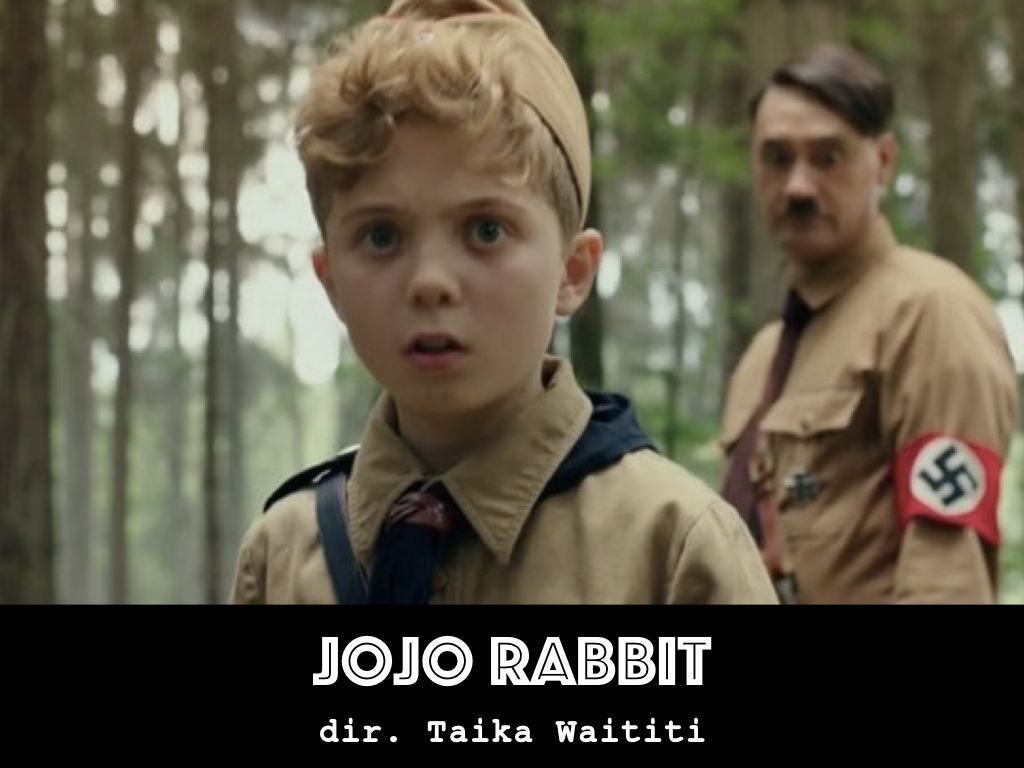
The story of a Hitler Youth whose imaginary friend is Adolf Hitler and who discovers that his mother is sheltering a Jewish girl in their attic was bound to be polarizing, but I'm continually amazed at the backlash to this film. I mean, not everyone has to like everything, but there are people who CANNOT WAIT to tell you how much they hate this movie and how garbage it is. Clearly, I am not one of those people. I love everything about it, perhaps especially the fact that it never forgets the two most significant things that it is: a movie about a child, from a child's point of view, and a movie about a totalitarian regime in which anyone who resists finds themselves hanged or shot. It walks the line between those two very different worlds exceedingly well, I think. The cast is uniformly great, starting with Roman Griffin Davis as the titular Jojo, who is obviously not cut out to be a Nazi and only aligns himself with them, as another character points out, because he wants to belong to a club. My absolute favorite person in the movie, though, is Archie Yates, who plays Jojo's friend Yorki and is so adorable I can't take it. There are some really incredible moments in this -- the letters from "Nathan," the mystery of Sam Rockwell's character's loyalties, the absolutely ridiculous "Heil"-a-thon scene with Stephen Merchant, and maybe most of all, a scene where Jojo's mother lets him speak to his father, which is just a perfect and sweet picture of their little family and this mother's dedication to her son. This movie is such a great (and unintentionally timely) reminder of the importance of being kind, and how powerful that can be. (Still in a few theaters.)

But we must look a little closer. And when we do, we see that the donut hole has a hole in its center — it is not a donut hole but a smaller donut with its own hole, and our donut is not whole at all!
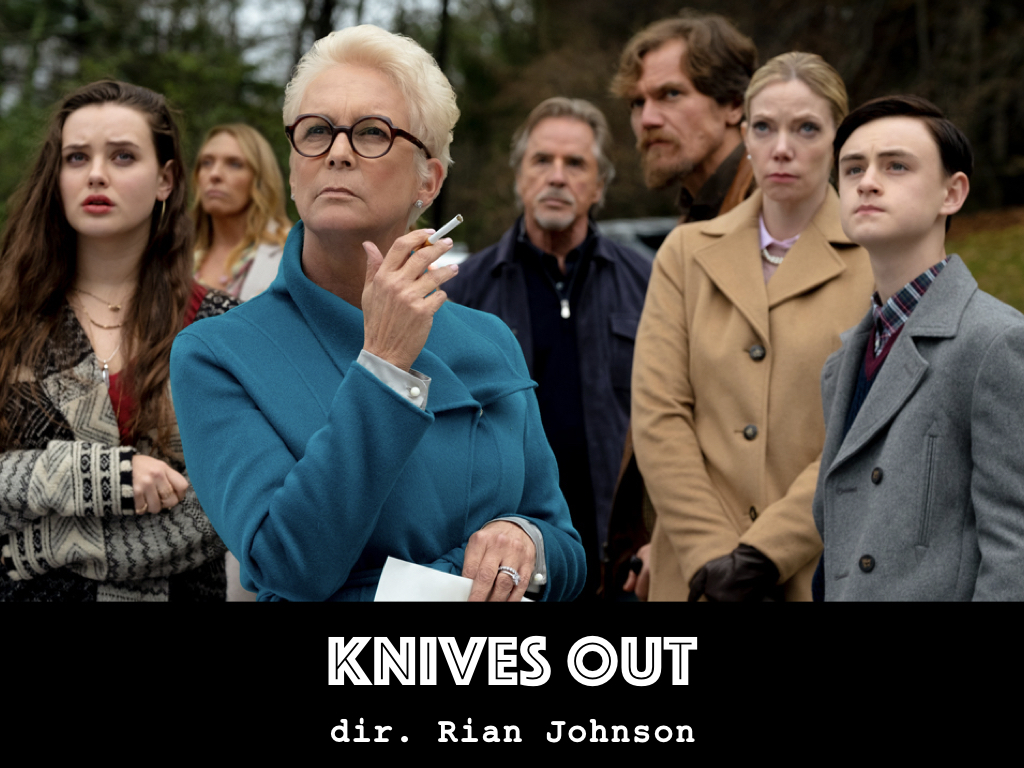
I'm sure there are flaws in this movie, but I see none. It is such a tightly crafted, well-executed, and ultimately satisfying murder mystery the likes of which we haven't seen in a long time. People keep calling this a "whodunit," but that seems to miss the point pretty spectacularly. The question isn't "who"; the question is what was done in the first place. This is an especially rich movie for rewatches, as you'll catch so many things (like scorch marks on letters) that were staring you in the face the whole time. I've already written a bunch of rambly thoughts on LJ about this movie (major spoilers at link), but the most enduring thing about this movie to me, even more so than the delicious stand-out performance of Daniel Craig, is Ana de Armas as Marta, especially her relationship with Christopher Plummer's Harlan. They only have one scene together, but it's the heart of the movie. (Side note: I'm also looking forward to seeing Ana de Armas reunited with Daniel Craig in the new Bond movie in 2020.) (In theaters.)

Women, they have minds and they have souls, as well as just hearts. And they’ve got ambition, and they’ve got talent, as well as just beauty. And I’m so sick of people saying that love is just all a woman is fit for. I’m so sick of it! But I’m so lonely!
All of the adaptations of Alcott’s novel have their charms, and I’m still quite fond of the Gillian Armstrong one, but this one might be the best. It’s as much an essay about the novel as an adaptation and you can see director Greta Gerwig working through some things, most notably the ending. I do wonder how this plays for viewers not familiar with the story, because it’s clearly assuming most people have, but not getting bogged down in the ABCs of introducing characters as if they’re entirely new creations helps Gerwig get to her more meta aims with this movie. Starting and ending the movie with Jo the professional writer is brilliant. Also brilliant is the decision to let us see grown-up Amy with Laurie before we ever see him with Jo, as well as the movie spending so much time with Amy and Laurie (easily as much as, maybe more than, Jo and Laurie), so that it’s easier to root for them and not get too attached in another direction. I’ve been meh on Saorsie Ronan in the past (I don’t deny she’s a great actor, but it feels like she gets ALL the roles, and I wish some other women of her generation got some of her share), but she’s really phenomenal in this. Florence Pugh (who will show up again in my number ones) is literally the best Amy, and I love that they had one actor play the younger and older version. Laura Dern is great, as always, and Meryl is Meryl. Human Eyelash Timothee Chalamet is wonderful. But my MVP is actually Chris Cooper, who plays Mr. Laurence. His relationship with Beth is my favorite thing about the movie. (In theaters.)

Nicole: The only reason we didn’t live here is you can’t imagine desires
other than your own, unless they’re forced on you.
Charlie: Okay, you wish you hadn’t married me. You wish you had a
different life. But this is what happened.
I often think of Noah Baumbach as this kind of chilly purveyor of schadenfreude whose movies are emotionless intellectual exercises. Then I remember he made one of my favorite movies of a few years ago, Frances Ha, and I have to concede that his movies are chock full of emotion. They're just also full of uncomfortable realism in his characters and their relationships, which I frequently find hard to watch. Marriage Story is sort of the apotheosis of all of that. "A love story told through divorce" is how he describes it, and that's about as good a pitch as you can get. We begin with essays Nicole and Charlie have written about what they love about each other, which turn out to be the first step in what they hope will be an amicable separation and eventual divorce. Things don't quite work out that way, though, and this movie follows all the complications of divorce, with the added complications of a child in the mix, as well as the difficulty of each party to the divorce living on opposite coasts. This is a beautiful movie, with tons of moments that have really stuck with me (I still can't think of the "knife trick" without reflexively grabbing my arm). It also has two full numbers from Sondheim's Company ("You Could Drive a Person Crazy" and "Being Alive"), which puts it among the many films this year that have used a Sondheim song in a key moment (like the John Denver trend two years ago). (Available on Netflix.)

KEEP ON SHOOTING! KEEP ROLLING!
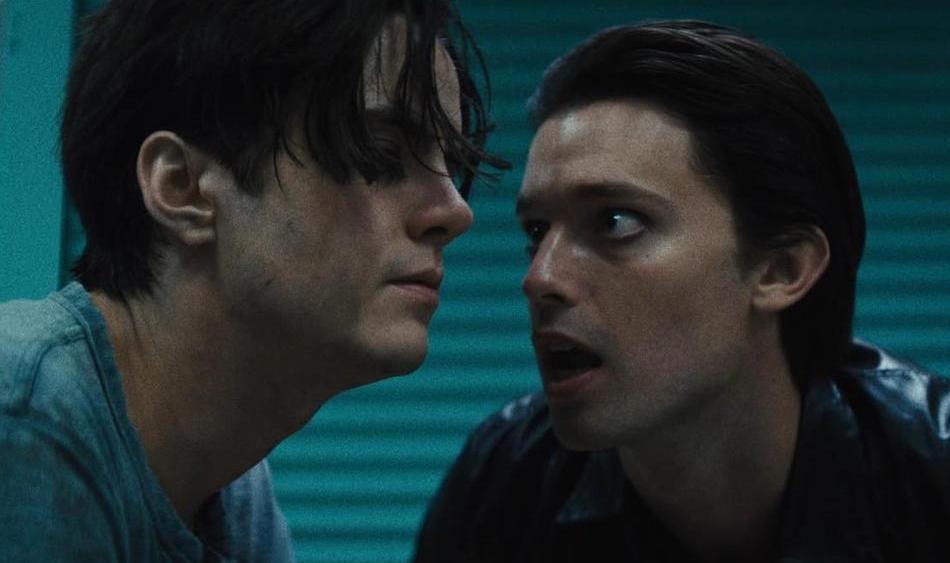
This pure cinnamon roll of a movie is an utter delight from start to finish, but the first time you watch it you might wonder what the fuss is about for the first half. Because what makes this movie special is the way it pays off every strange or awkward first-half moment in the second half. The whole cast in this is really great, from the mom-dad-daughter trio that is the heart of the movie, to the tiny network executive woman who’s so excited about everything, to the crew member blowing fake blood through a tube to imply an ax hitting a body. This is such a love letter to scrappy, independent filmmaking that my heart burst and I am speaking to you now from the Beyond. The image above is part of a particularly great moment that is a perfect portrait of creative collaboration, so much so that it brought me to tears. It will have you shouting “POM!” to random strangers on the street. It will have you almost as on edge as when you watch Uncut Gems. And it might make you want to go out and make your own movie. (Available on Shudder and for rent on other streaming services.)

I believed that the strength of my love would overcome his addiction, but it did not. Love is not enough. Love may move mountains … but it’s not enough to save the person you love.
Like The Irishman, Pedro Almodóvar's Pain and Glory is a reflection on a career. Our protagonist, Salvador (played by Antonio Banderas in what could be a career-best performance), is a filmmaker in decline, physically and to some extent creatively. We jump around between a few different periods in his life -- his childhood, the end of a relationship with the love of his life, and his caring for his ailing mother. Salvador has essentially surrendered to the constant pain in his body and all but given up on making films (mainly because his physical difficulties make the demands of a film shoot all but impossible) — apparently inspired by a prominent fear of Almodóvar's, that he would eventually no longer be physically able to make films. But after a series of encounters that bring him perspective on his life and career, he takes steps to improve his health and is inspired to start making films again. This film is gorgeous, and much more subdued and contemplative than you might expect from Almodóvar. Incidentally, I did love that what we see of "Sabor" (the fictional film of Salvador's that has been restored and rereleased) looks like peak Pedro. And there is a reveal in the final scene that recontextualizes most of the rest of the film in a beautiful way. (In theaters.)
Ki-taek: They are rich but still nice.
Chung-sook: They are nice because they are rich.
A lot of Bong Joon-Ho's films have been about class, most overtly Snowpiercer, but here he takes that theme and gives it a Hitchcockian spin. On a tip from a friend, Ki-woo gets himself hired as a tutor for a young girl in a wealthy family who lives in a beautiful modern two-story architectural marvel of a home. Ki-woo's own family is poor, living in a tiny basement apartment and struggling to make ends meet with low-paying temp gigs like folding pizza boxes. Ki-woo's sister, father and mother all manage to con their way into working for the wealthy family in various capacities, but the class disparity creates uncomfortable situations and resentment, and eventually much worse. This would make a perfect triple feature with Knives Out and Us, as all three of these films deal with class and people's willingness to do horrible things to preserve what they perceive is theirs. It's an immaculately constructed film that, every once in a while, lets you feel like you have a feel for what's happening and what's going to happen, only to pull the rug out from under you and topple your expectations a few minutes later. Which is why the less I say about it, the better. (In theaters.)

When will you marry?
I don’t know if I will.
You can choose. That’s why you don’t understand me.
This movie, like its subject, is a work of art. More than a story about an illicit romance, it is a film that examines women's lives and the options and choices available to them, and how they rebel when they bump up against society's limits on them. This movie celebrates women and their desire for independence — financial and professional independence, independence from marriage, independence from forced child-bearing, and independence from a life that revolves around men. The burgeoning romance between the painter, Marianne, and her subject, Héloïse, is obviously the centerpiece of the film, but this movie also strongly emphasizes the friendship of the two women and the young maid, Sophie, who is in the house with them. In particular, there is a sequence with this lady trio, while Héloïse's mother is away, that is so audacious (at least to my American eyes) that I could hardly believe it (in the best way). (Opening in the US in February.)
Aren’t you tired of checking your phones all the time? Wondering if someone’s trying to reach you when no one ever is? How many times a day is there nothing?
I’ve seen a lot of teen romcoms in my day but I don’t think I’ve ever seen one so sex-positive and non-judgmental. (The characters do plenty of judging, but the film doesn’t.) This Quebec-made film follows three young women who take jobs at a toy store because their heads are turned by the cute guys who work there. One of the girls, Charlotte, has recently had her heart broken and rebounds many times over with most of the male staff. After finding out the guys have made a sort of game of it, and drawing the ire of most of her female coworkers, she decides to start a fundraiser for charity, wherein she will take pledge money for abstaining from "romance." She is quickly joined by the other female workers, while the guys, upset at the disruption to the social network of the staff, eventually start their own pledge drive. This is a charming examination of the complicated emotions and relationships between young people, as well as the double standards facing women when it comes to sex. There’s a bit of Lysistrata, some A+ usage of Maria Callas, and it even closes with a Bollywood dance number. It’s fairly formulaic on its face, but it uses the well-worn romcom tropes to say some important stuff. (Available on most streaming platforms.)

Once upon a time, there was a Tiger Prince…
This is a very different kind of horror movie, a rare "tear-jerker" in this genre, and I wasn't surprised when it showed up on Shudder and some people were disappointed with it. It's not your typical horror flick and is much more along the lines of a Guillermo del Toro movie (most closely resembling The Devil's Backbone), where the story and stakes are much more serious and grounded. The movie takes place in a city in Mexico that has been decimated by the drug cartels. The city is essentially a ghost town and our heroine, Estrella, is on her own after her mother disappears and classes at her school are suspended indefinitely. She soon joins up with a group of boys under similar circumstances, and they all try to survive together. One of the boys, Shine, steals a cell phone and a gun from one of the drug dealers who is too drunk to do anything about it, and this sets up the conflict for the rest of the movie. This is tough to watch, but strangely beautiful and unfortunately timely, with some truly brilliant and devastating child performances. There is literally a shot of a child in a cage that absolutely destroyed me. If you watch horror films expecting gory deaths every five minutes, you should check your expectations at the door, but this is well worth seeing regardless. (Available on Shudder and for rent on most streaming services.)

There’s a saying: God always corrects one Pope by presenting the world with
another Pope. I should quite like to see my correction.
This movie was a complete surprise to me (I'd never even heard of it before I saw the trailer in front of The Irishman), and I didn't expect to fall for it like I did. I'm not a Catholic but I was raised Southern Baptist (and the child of someone who was a sort of religious leader, though he would laugh at being called that), so while the pomp and ceremony is something kind of alien to me, there are still remnants for me to latch onto. The movie is sort of bookended by the election of the two titular Popes, and what comes between is a fascinating interaction between them. The two Popes in question being the current Pope (for most of this film, Cardinal Bergoglio, played by Jonathan Pryce) and his predecessor (for most of this film, Pope Benedict XVI, formerly Cardinal Joseph Ratzinger, played by Anthony Hopkins). They clash frequently, due to their different personalities and Bergoglio's more progressive stances, but they have some common ground. Bergoglio has specifically come to visit Pope Benedict to announce his intentions to retire, but the Pope won't hear it and eventually announces his own intention to resign from the papacy, a move unheard of and not taken in 600 years. The Cardinal begs him to reconsider, saying that resignation will damage the papacy, and rebuffs the Pope's suggestion that he might be a successor, saying that he is unfit to be Pope due to mistakes in his past (shown to us in flashbacks). This was a remarkable film, with discussions of these two men's faith that reminded me a lot of Silence. In particular, there's a long sequence in a recreated Sistine Chapel that's remarkable to look at even without the dialogue. I wonder how this plays for people who aren't religious (especially for people who understandably can't help tuning out anything to do with the Catholic Church). But I found it beautiful and moving. (Available on Netflix.)